
Designing the Triangle Site: The Trainees take on Permaculture
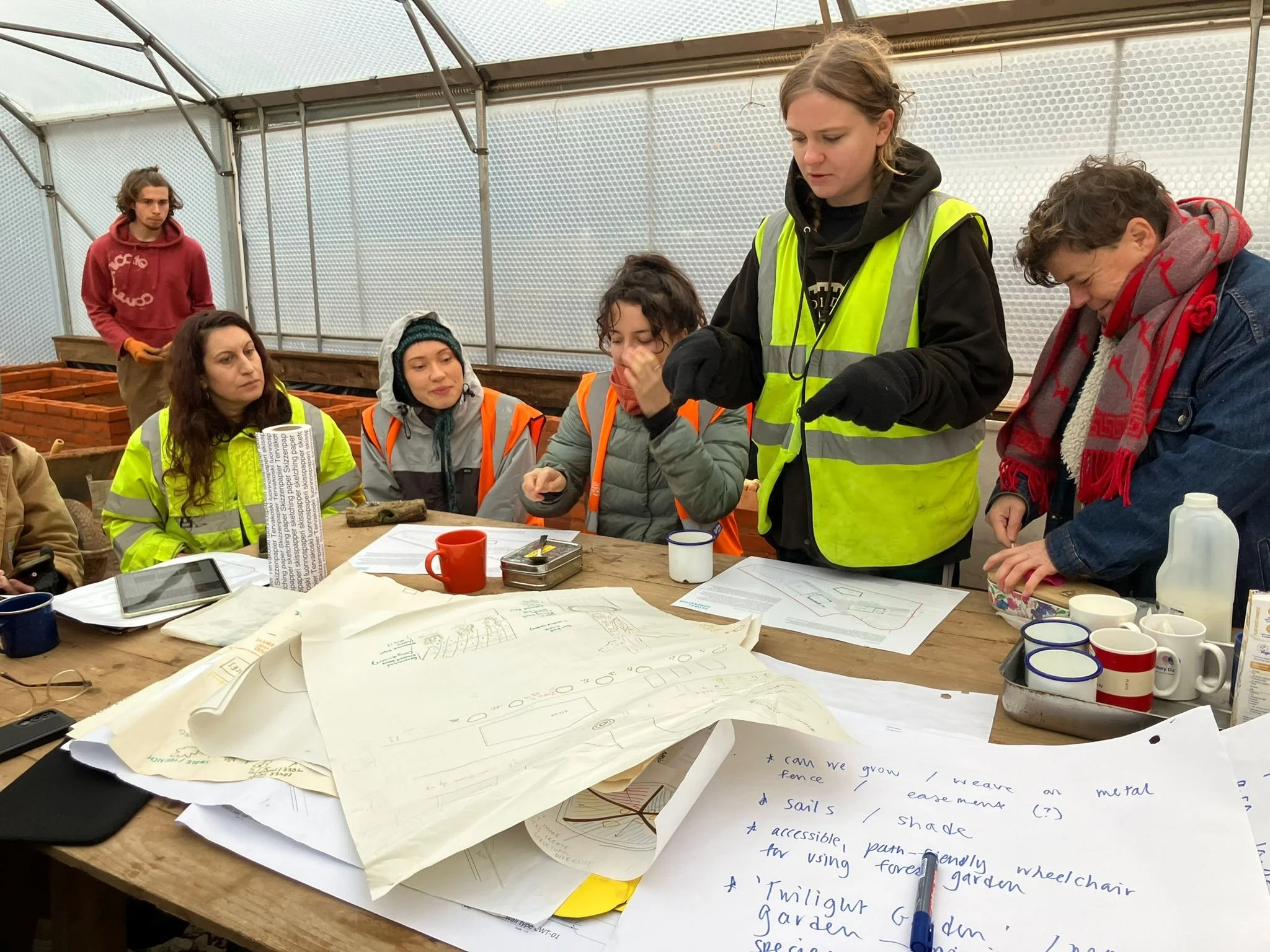
As part of the garden traineeship, we completed a permaculture design course (run by Rakesh from Roots n Permaculture). Since May, we’ve taken a deep dive into permaculture; what it is, how it works and how it can be applied anywhere and in any context. Here’s what we’ve been up to.
So what is permaculture…?
The term “permaculture” was coined by David Holmgren and Bill Mollinson; a blend of permanent agriculture and permanent culture. As such, it is often associated with food growing and garden maintenance systems. More broadly speaking, it is a method for thinking about how we design self-sufficient, closed loop systems that aim to minimise external inputs and reduce waste outputs (or pollution) as much as possible.
The teachings of permaculture reflect various principles of indigenous culture, knowledge and practice, particularly with reference to our relationship to the earth. You can see this reflected within the three ethics that sit at the core of permaculture practice:
1) Earth care
2) People care
3) Fair share
Indigenous knowledge systems have been either disregarded, lost or actively suppressed during colonial regimes. The legacy of this means a modern agricultural system favouring extractive and exploitative methods that continues to facilitate a global ecological crisis.
Permaculture systems exist in direct opposition to this. They are designed to be not just sustainable, but regenerative, which makes it a more revolutionary alternative to traditional sustainability models. This leads me to my favourite definition; ‘permaculture is the revolution disguised as gardening’. Taking the Permaculture Design Course meant learning a set of tools, methods and principles that could be applied across a range of sites - from a tiny back garden, a city, completely off grid, or to a brownfield site, like the triangle site. We had a really unique experience to design a site which we would be helping to build over the coming months. Here’s a quick insight into how we adopted different tools and methods of permaculture to imagine what the triangle site could be.
Sociocracy Governance Models
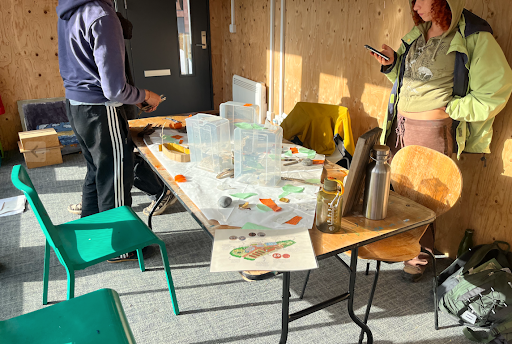
Sociocracy is a self-governance model that feels especially relevant in the context of working in community projects. What I liked was the acknowledgement that just because you’re in the same group, community or project as someone, it doesn’t mean you’re there for the same reason. Like a community garden - some people are there to garden, some people want to see the biodiversity, some people just want to build connections and some people are just there for the free lunch. You have to acknowledge this to move forward.
Creating a shared vision that you can all agree on is a great way of getting started. Rather than the traditional democratic, everyone votes and the most votes win; we adopted a sociocratic tool; to consent, consent with concern, or object. When working towards a shared vision, objection doesn’t mean rejection, it’s in aid of a shared vision. We found this actually super useful and decided we would each write out our personal visions for the triangle site…
“The integration of human and nature”
“How to incorporate ‘play’ into natural space”
“Concentrated interactive space”
“Creating an abundance in limited space”
“Making the most for community and biodiversity”
“A space for retaliation/centring marginality”
…and combine them to create a shared vision we could all consent to
“To get the most out of a small space in terms of biodiversity and community building through playful education”
We then considered the permaculture ethics of earth care, people care and fair share to create 3 core values to centre our designs around:
“Play and Education”
“Accessibility and Inclusion”
“Biodiversity and wildlife”
Dragon Dreaming
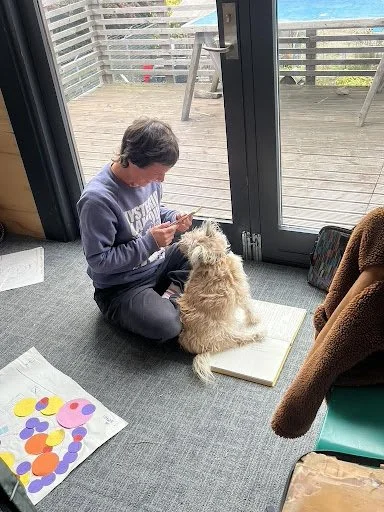
The idea behind dragon dreaming is understanding your role in a project through the categories of ‘dreamers’, ‘planners’, ‘doers’ and ‘celebraters’. We found that none of us really fit into one box, but we considered our respective strengths and weaknesses and it felt like a really nice reflective tool to think about how to work together going forward. We then had a collective dreaming session where we thought about the different features and ideas for the triangle site.
Survey and Analysis
Survey and Analysis are the first two components of the SADIMET tool; Survey, Analysis, Design, Implement, Monitor, Evaluate, Tweak. It is probably the most important part of the design process, and we found ourselves constantly returning to it when considering both the possibilities and limitations of the triangle site.
The triangle site has a lot of limitations that we had to consider.
Sunlight is limited, especially in winter due to surrounding tall buildings.
Brownfield land: the ground is sealed due to previous contamination and varied excavation limits exist across the site
Terrain the site slightly slopes down toward the traintracks
National Rail restrictions:
Trees we plant cannot exceed 2 meters height
A fixed boundary across the sites perimeter exists to allow access to the railway
No ponds allowed
We were also working with an existing (and currently outgoing) plan that contained some fixed elements (like the kitchen, classroom, polytunnel and office), but also some spaces which have more room for manoeuvre - which we decided to focus on.
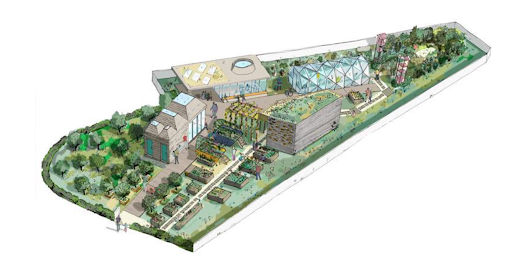
This led us to focus on 6 specific areas of the site:
Pathways
Forest Garden
Food Growing Area
Water Harvesting Systems
Resilient Garden
Meadow/Woodland
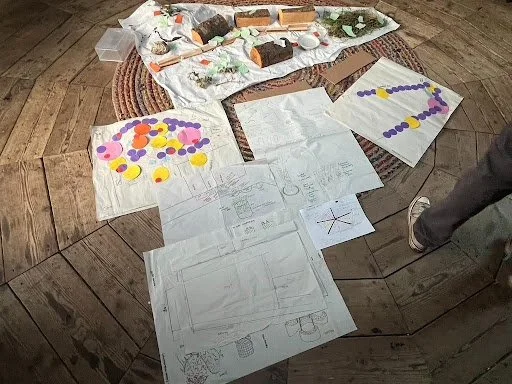
Planning for Real
Planning for real was a really great tool for starting to think about how these different areas and systems would work together on site to carry out our goals for this project. This consisted of us collecting random items, scraps of paper and mapping them out to start to understand the site itself, and what functions different spaces would encompass. This allowed us to then split off and focus on more specific areas on site, knowing that it would align to the rest of our plan.
I’m going to very quickly describe some of the features that were designed for the different areas on site - and the thought processes behind these decisions.
Pathways
We decided the pathways should be a central part of our design, controlling flows of people and ensuring the site is accessible for all users. The entrance to the site would include a metal grid with a herbaceous underlayer, that creates an aromatic sensory experience as you enter the site. We wanted to work with the existing pathways (often paved or wooden to allow for wheelchair users), whilst also creating small additional paths, some that felt more hidden. We played a bit more with the materials for the hidden pathways, using woodchip to create ‘mycelium superhighways’ that transport nutrients in the soil between the different areas on site.
We considered creating a standing dead wood totem pole - with the purpose of creating a central meeting point, a convergence between the different zones on site. Deadwood doubles as both a great habitat for invertebrates and creating a significant point where people can stop and reflect together.
Forest Garden
The forest garden was first designed by surveying the trees available to us from the story garden to make sure we were working with what we had access to. We then considered what additional plants we want (for food, medicine or herbs), along with what wildlife might want (for habitat or food) and finally what the plants need to survive (nitrogen fixers, soil regenerators etc). The plants were then selected based on these qualities, alongside with the available space for them to grow and thrive.
We wanted to incorporate other features like loggeries to reinforce the soil mound, but also to create new opportunities for wildlife and invertebrates through varied habitats and deadwood. A moon garden was also a feature that we thought would be cool, planting for nocturnal animals and creating a richer biodiversity on site, as we often forget to cater for nocturnal animals and plants.
Food Growing Area
This area we wanted to be a more social space, right by the entrance, welcoming people into the garden and straight into the food growing area. We designed planters with multiple functions, food growing, seating - stacking functions is a key tool in permaculture (‘yield is theoretically unlimited’). Thinking about the shape they would take, we wanted to move away from rigid squares/rectangles and considered how circular forms tend to encourage socialisation and connection. As such, the planters were designed to meander through the space to control flows of people through the garden, but also to encourage people to slow down and interact with the food growing if they feel like it.
When thinking about materials for the planters/composting, we considered a gabion mosaic (as seen in John Little’s garden), that uses waste materials and rocks, maintained by a metal grid, creating habitat for invertebrates, but also an opportunity for color and creativity!
We also considered growing food using hugel mounds. This technique means digging a trench, placing logs and pieces of wood that decay over time slowly regenerating the soil. This creates a nutrient rich bed for food growing, and a great opportunity to learn about alternate methods for growing in cities!
Water Harvesting Systems
The accessible planters built into the decking were designed to be watered through a grey to green water treatment system. Run off from the taps outside the kitchen could be collected, filtered and connected to the base of the planters (underneath the decking) to reduce water waste. This would also create an opportunity for education about grey to green water treatment by displaying the water filtration system through varied substrates (like stones, pebbles and activated charcoal).
Resilient Garden
The resilient garden was designed as an opportunity to think about growing in extreme conditions - which is super important given the impact of climate change on our ability to grow food. As such a focus on dry, herbaceous plants, alongside a wetland ‘pond’ like area, reflecting growing in drought/flooding. The wetland area also doubles as a water harvesting system, capturing water collected from the office roof. This creates a space for water loving plants to thrive, which actually helps prevent flooding and run off onto the railway tracks below.
Meadow/Woodland
We wanted to feel the least managed, to allow for play that is a bit more wild! Starting as a larger open space, for big groups to gather, it follows the rules of succession, with a wildflower meadow and then a more unruly hedgerow/ woodland area at the back of the site. The idea here was to let the natural progression of nature control the natural progression of play. Where the open space for running around, is controlled slightly in the wildflower meadow (by little mounds and changes in terrain), to finally the woodland area creating smaller spaces for break off and solo discovery!
Notes from the Garden
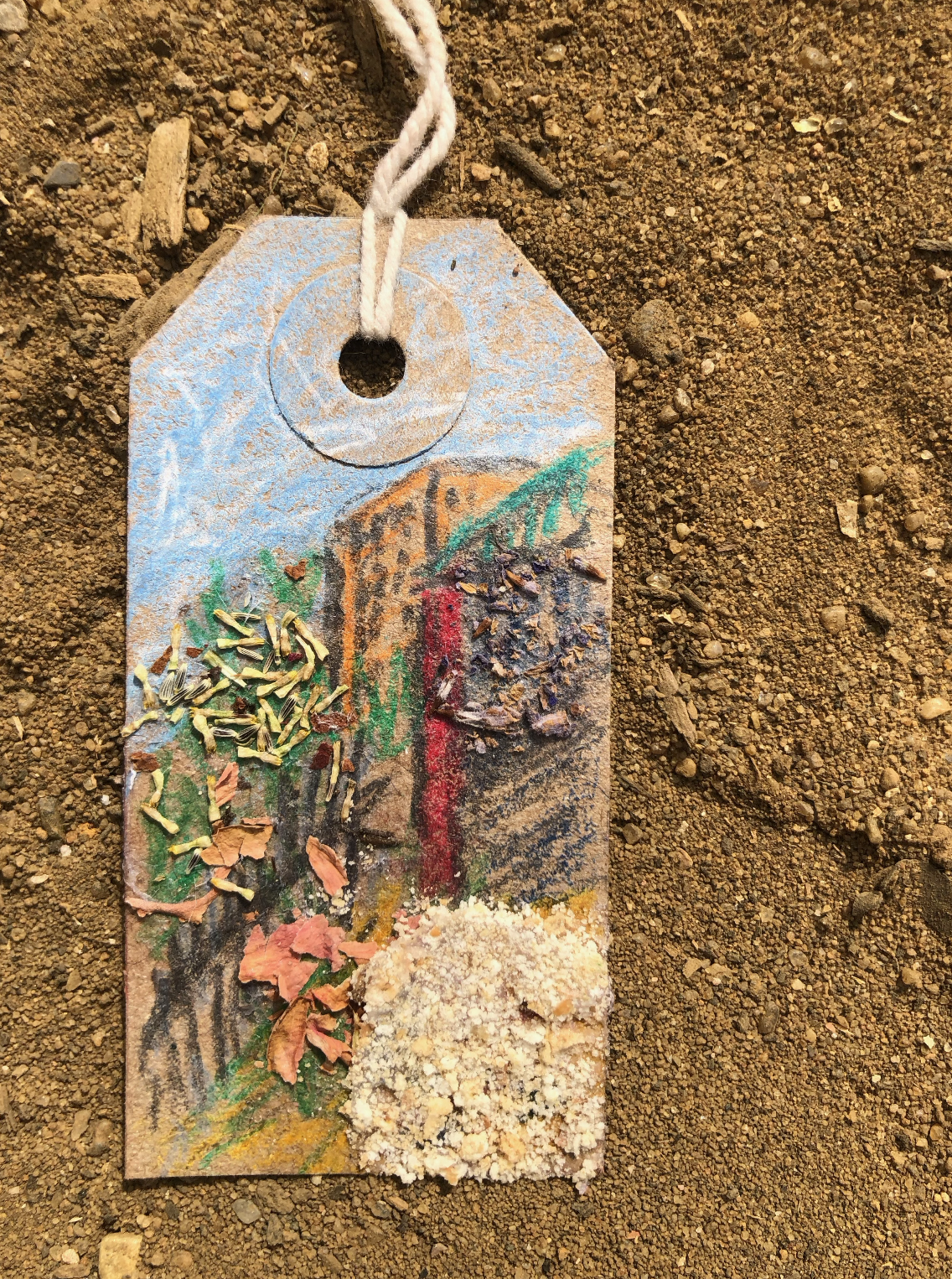
In this story, Linda goes back to December 2023 where school children from Edith Neville and Rewilding Children’s Imaginations funders , Pia Jones and Sarah Pimenta, took a deep dive into London lost rivers. A story about how a project from the past can still inform programmes in our new Story Garden.